

 Click the left links to find technical parameters
For crane wire ropes, common standards include GB/T 20118, YB/T5359, ISO2408, EN12385-4 etc with good quality and long service life.
Rotation resistant steel wire ropes, such as 15×K7-IWRC, 18×7-WSC(19×7), 24(W)×7, 35(W)×7 and 35(W)×K7, which are widely used as main hoist rope for tower crane, mobile crane, crawler crane and gantry crane, are our star product which excel in anti-rotation properties, load-bearing capacity, and durability, making them a viable alternative to European, Japanese and Korean brands and providing a more cost-effective solution for your projects.
Download the catalog of crane ropes
Download the catalog of general ropes

Click here if the video below fails to play
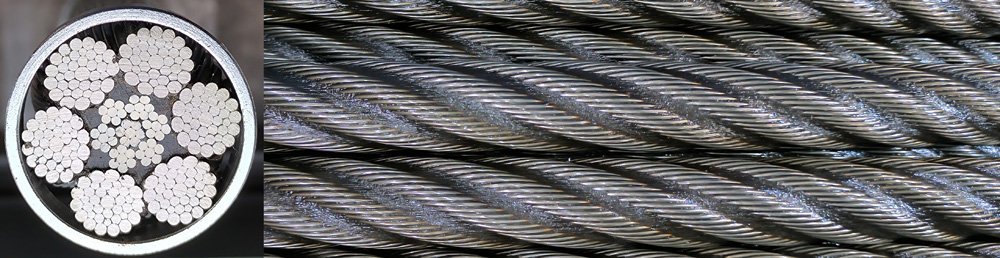
Single-strand steel wire rope: generally, there is only one layer of strands around the rope core. RHRL is commonly used. Anti-rotation performance is generally average, such as 6×19S and 8×K19S.
Multi-layer steel wire rope: generally, there are at least two layers of strands around the rope core, with adjacent layers having opposite lay directions. It has better anti-rotation property, such as 18×7-WSC, 24(W)×7, and 35(W)×7.
Main hoisting rope: It is recommended to use steel wire ropes with parallel laid wire + steel core + anti-rotation construction, such as 35(W)×7 and 35(W)×K7, commonly used in tower cranes, crawler cranes, mobile cranes etc. The rotation resistant property is much better.
For main hoisting wire ropes that require repeated bending and pass through multiple pulleys in the hoisting structure, it is recommended to use steel wire ropes with parallel laid wire/compacted wire + fiber core/steel core + single-layer construction, such as 6×36WS-SFC, 6×36WS-IWRC, and 8×K26WS-IWRC, commonly used in port container gantry cranes.
Luffing structure and trolley system: It is recommended to use steel wire ropes with cross laid wire/parallel laid wire + fiber core + single-layer construction, which offer better bending performance, such as 6×19M-SFC and 6×19S-SFC.
Working environment: For outdoor work, galvanized work or heavy lubricating work is preferred. For indoor operations, non-galvanized work can be used to reduce costs.
Fiber core (FC): the rope core has better oil storage performance and the steel wire rope has better flexibility.
Steel core (IWRC): high temperature resistant and compression resistant, commonly used in lifting equipment with heavy loads.
Steel core (PWRC): It refers to a specific type of IWRC where the strands in the rope core are laid parallel, rather than being twisted (braided) together like a standard rope. Usually, ropes with PWRC have higher MBL than ropes with IWRC.
Cross laid: low cost, suitable for light load binding, good flexibility, poor wear resistance, like 6×37M-SFC
Parallel laid: such as Seale (S) and Warington type (W), low contact stress, long service life, like 6×19S-SFC
Compacted: high steel wire tensile strength, commonly used in lifting equipment with large tonnage loads. like 8×K26WS-IWRC